
I Attended Last Night's Data Center Town Hall in Federalsburg. Here Are My Takeaways.
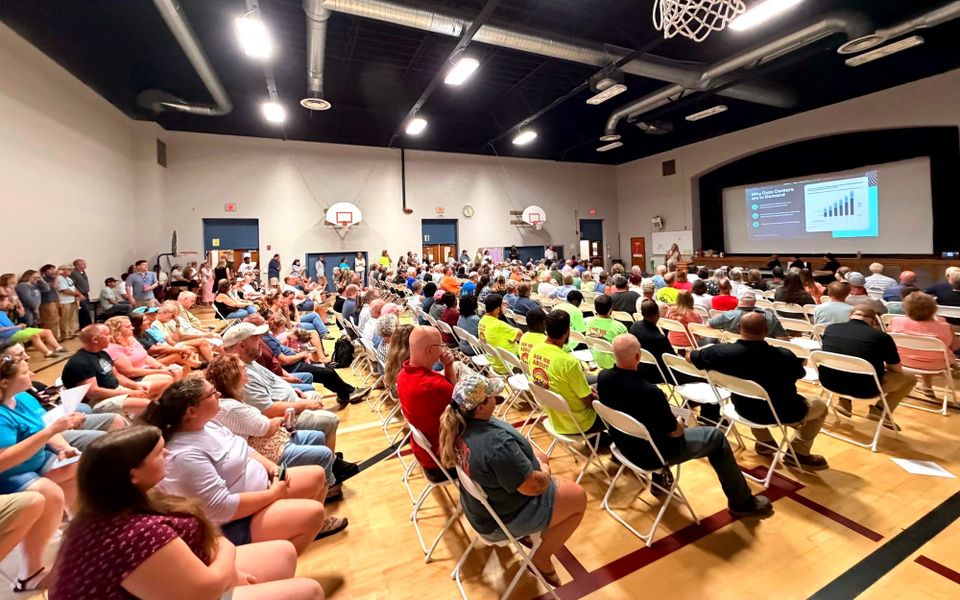
Last night, the gymnasium at Federalsburg Elementary was standing room only.
Residents, union workers, elected officials, and concerned neighbors packed the room to hear a presentation about the proposed Fieldstone data center in Caroline County. When residents had the chance to speak, the message was overwhelming: this community does not want a data center.
I was there as a neighbor. My mother grew up in Denton, and my grandparents lived there for several decades. Caroline County is not unfamiliar territory to me. I also spent five years in enterprise technology sales, including server hardware and cloud infrastructure.
The developer cited 160 jobs. When pressed on specifics, they acknowledged they don't yet have a project plan to reference. Promises without a plan aren't commitments; they're talking points.
The developer also said their cooling system is essentially a closed loop. Here is the problem with that. There is no large-scale data center that operates with zero water loss. Heat has to go somewhere. When it dissipates through evaporation, water leaves the system. The developer indicated that their cooling system would draw from the town's wastewater supply. That brings us to Federalsburg's wastewater treatment plant.
The proposed Fieldstone facility would span 80,000 square feet. Federalsburg's wastewater treatment plant is rated at 750,000 gallons per day. Roughly 380,000 gallons are currently consumed daily. A mid-sized data center can consume between one and five million gallons of water per day. Even on the conservative end, the math does not work. When the treatment plant runs out of capacity, the water has to come from somewhere else.
That somewhere is, likely, the Choptank aquifer. It runs beneath both Caroline and Talbot Counties. It does not stop at the county line.
What happens in Federalsburg does not stay in Federalsburg. Talbot County residents, farmers, and private well owners draw from the same aquifer. That is why Talbot County needs to be included in any environmental review.
Talbot County could formally request inclusion in any state environmental review of this project. Our County Council could send a letter to the Maryland Department of the Environment asking that Talbot County be designated as an affected jurisdiction before any permits are issued. That is not opposition for its own sake. That is basic due diligence on behalf of the people who drink from these wells and farm this land. If elected, I will champion this effort and work to build the coalition of local officials, farmers, and residents it will take to see it through.
I have written previously about why Talbot County should resist pressure to site data centers within its own borders. The risks do not stop at our county line. Our neighbors in Caroline County raised their voices last night. Talbot County should be paying attention.
If you believe Talbot County deserves a representative who will fight to keep data centers out of our county, I hope you will consider supporting my campaign. Every contribution helps us reach more voters across the county.

Frank Gunsallus is the former President of the Easton Town Council and a candidate for Talbot County Council.
--
Authorized by: Friends of Frank Gunsallus, Paul Hagood, Treasurer
--
Works Cited
Caroline County Department of Planning and Codes. 2026 Federalsburg Comprehensive Water and Sewer Plan Sewer Map Amendment. Caroline County, Maryland, 2026, www.carolinemd.org/DocumentCenter/View/12046/2026-Federalsburg-CWSP-Sewer-Map-Amendment-Public-Hearing-Info-Summary.
Lawrence Berkeley National Laboratory. Water Efficiency. United States Department of Energy, datacenters.lbl.gov/water-efficiency. Accessed 14 July 2026.
Lincoln Institute of Land Policy. "Data Drain: The Land and Water Impacts of the AI Boom." Land Lines, Lincoln Institute of Land Policy, www.lincolninst.edu/publications/land-lines-magazine/articles/land-water-impacts-data-centers. Accessed 14 July 2026.
Maryland Geological Survey. "Coastal Plain Aquifers in Maryland." Maryland Department of Natural Resources, www.mgs.md.gov/groundwater/coastal_plain_aquifers_mobile.html. Accessed 14 July 2026.