
I Work in the Tech Industry. Here's Why I'm Opposing Data Centers in Talbot County.

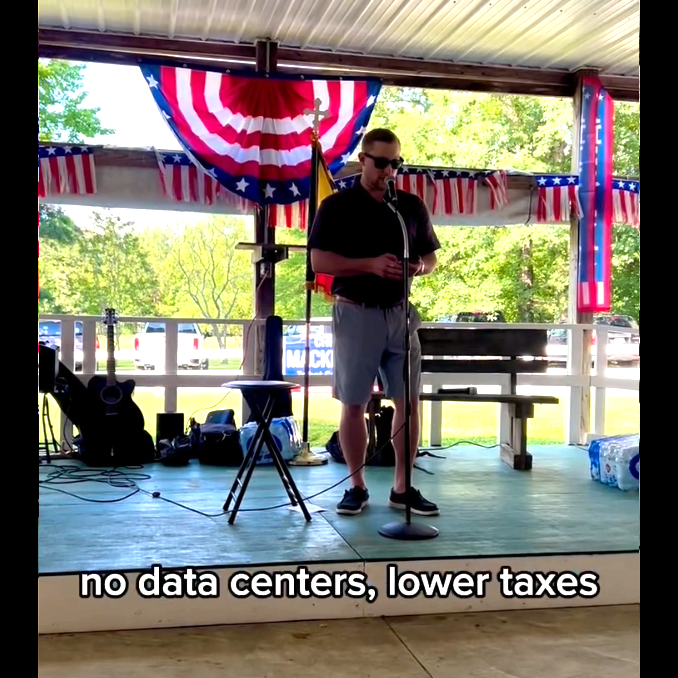
If you have been following my campaign, then you may have seen my speech where I mentioned "no data centers" in Talbot County (pictured and linked below). I want to take a moment to explain the reasoning behind that position.
For five years, I worked in enterprise technology sales, selling infrastructure as a service and server solutions to businesses. That meant understanding the technology well enough to explain it clearly to CEOs and executives who ask hard questions. I know how these facilities work and what they demand from the communities that host them. It is the basis for my concern.
Data centers are large-scale industrial facilities, not office buildings or employment centers. A single facility can occupy hundreds of thousands of square feet, employ as few as 30 to 50 full-time workers, and place significant demands on local infrastructure. Here is a straightforward look at the issues I believe Talbot County residents deserve to understand before any such facility is proposed here.
Power & Water
Power consumption. A single large data center can consume enough electricity in one year to power 80,000 to 100,000 average American homes. Maryland is already an importer of electricity. According to testimony presented to the Maryland General Assembly by PJM Interconnection in January 2025, Maryland has seen the retirement of 6,000 megawatts of power generation since 2018, while adding only 1,600 megawatts of new capacity. Policies in Annapolis have accelerated those retirements. Adding the industrial electricity demand of a data center campus to a grid that is already strained and dependent on out-of-state power is not a risk Talbot County should take. The cost of grid upgrades is typically passed on to ratepayers. (Source: PJM Interconnection, Testimony to the Maryland General Assembly, January 2025; Congressional Research Service Report R48646)
Water usage. A mid-sized data center can consume up to 110 million gallons of water per year for cooling. Larger facilities can require up to 5 million gallons per day. On the Eastern Shore, where the health of the Chesapeake Bay and our waterways is a longstanding priority, that level of industrial water consumption warrants serious scrutiny. (Source: Environmental and Energy Study Institute, 2023; Lincoln Institute of Land Policy, 2025)
Noise, Light, Health
Noise pollution. Data centers operate continuously. The industrial HVAC systems and cooling towers produce a constant low-frequency hum, and diesel backup generators add additional noise during power outages and scheduled testing cycles. Residents in Prince William County, Virginia have reported data center noise levels routinely exceeding 60 decibels. The EPA has published Clean Air Act resources specific to data center development, acknowledging their documented pollution profile. (Source: EPA.gov, Clean Air Act Resources for Data Centers; World Resources Institute, 2025)
Light pollution. These facilities are lit and active 24 hours a day. Constant security and operational lighting disrupts sleep, affects wildlife, and alters the character of rural landscapes in ways that are difficult to reverse. (Source: NIH/PMC, Global Data Center Expansion and Human Health, 2025)
Health considerations. A Washington Post investigation published in May 2026 found that diesel generators at data centers in Virginia produce enough pollution to cause respiratory harm even when used rarely. Research from Harvard T.H. Chan School of Public Health and the University of California Riverside confirms that data center diesel exhaust contributes meaningfully to local air pollution burdens and health costs. (Source: Washington Post, May 2026; Harvard T.H. Chan School of Public Health, 2025; UC Riverside, November 2025)
Quality of Life & Land
Quality of life. Beyond measurable data, the communities that have hosted data centers tell a consistent story: noise that does not stop, lights that do not go off, utility bills that rise, and a landscape that no longer looks or sounds the way it did. Talbot County's quality of life is not an abstraction. It is the reason people move here, raise families here, and retire here. It is worth protecting. (Source: Consumer Reports, AI Data Centers and Their Impact on Communities, 2025; World Resources Institute, 2026)
Land and agricultural use. This is not a hypothetical concern for the Eastern Shore. Caroline County and Federalsburg officials confirmed in June 2026 that a developer from Washington state has approached the town about building a data center in its industrial park. A public information session is scheduled for July 13, 2026. According to datacentermap.com, there are currently no data centers anywhere on Maryland's Eastern Shore. Talbot County should decide now, before a developer arrives at our door, what kind of community we want to be. Agricultural land, once converted, is rarely returned to productive farming. Our rural character supports tourism, property values, and the fishing and farming industries that define this region. (Source: The Star Democrat, June 26, 2026; Town of Federalsburg Public Notice, June 29, 2026)
On June 10, 2026, Harford County became the first county in Maryland to enact a full ban on data centers, with the County Council voting unanimously in favor of the legislation. I believe Talbot County should at minimum adopt a moratorium while a full public review is conducted, one that gives residents accurate information and a genuine opportunity to weigh in before any decision is made. (Source: Harford County Government Press Release, June 10, 2026; WBAL-TV, June 2026)
My position is specific: data centers do not belong in Talbot County. The land use demands, infrastructure strain, and quality-of-life impacts these facilities create are not compatible with what makes this county worth living in. There are parts of Maryland better suited to host this kind of industrial infrastructure. We are not one of them.
Major decisions about land use belong to the people who live here, and I intend to make sure Talbot County residents have a voice in that decision before it is made for them.
If you want a representative who will put Talbot County first on decisions like this, consider making a contribution using the donate button below. Every dollar helps us reach more voters before November.
Authorized by: Friends of Frank Gunsallus, Paul Hagood, Treasurer
Sources
1. Congressional Research Service - Data Centers and Their Energy Consumption: Frequently Asked Questions (Report R48646)
https://www.congress.gov/crs-product/R48646
2. Environmental and Energy Study Institute - Data Centers and Water Consumption
https://www.eesi.org/articles/view/data-centers-and-water-consumption
3. Lincoln Institute of Land Policy - Data Drain: The Land and Water Impacts of the AI Boom
https://www.lincolninst.edu/publications/land-lines-magazine/articles/land-water-impacts-data-centers/
4. U.S. Environmental Protection Agency - Clean Air Act Resources for Data Centers
https://www.epa.gov/stationary-sources-air-pollution/clean-air-act-resources-data-centers
5. World Resources Institute - From Energy Use to Air Quality, the Many Ways Data Centers Affect US Communities
https://www.wri.org/insights/us-data-center-growth-impacts
6. NIH / National Library of Medicine - Global Data Center Expansion and Human Health
https://pmc.ncbi.nlm.nih.gov/articles/PMC12273412/
7. Harvard T.H. Chan School of Public Health - Analyzing Air Pollution and Health Risks from AI Data Centers
https://hsph.harvard.edu/news/analyzing-air-pollution-health-economic-risks-from-ai-data-centers/
8. University of California Riverside - California Data Center Health Impacts Tripled in 4 Years
https://news.ucr.edu/articles/2025/11/21/california-data-center-health-impacts-tripled-4-years
9. The Washington Post - As Data Centers Boom, Virginians Breathe the Exhaust of 10,000 Diesel Generators (May 28, 2026)
https://www.washingtonpost.com/business/2026/05/28/data-centers-boom-virginians-breathe-exhaust-10000-diesel-generators/
10. Harford County Government - County Executive Cassilly Signs Historic Data Center Ban Legislation (June 10, 2026)
https://www.harfordcountymd.gov/CivicAlerts.aspx?AID=1700
11. Consumer Reports - AI Data Centers and Their Impact on Electric Bills, Water, and More
https://www.consumerreports.org/data-centers/ai-data-centers-impact-on-electric-bills-water-and-more-a1040338678/
12. The Star Democrat - Caroline County, Federalsburg Officials Exploring Potential for Data Center (June 26, 2026)
https://www.stardem.com/news/caroline/caroline-county-federalsburg-officials-exploring-potential-for-data-center/article_8d593189-1d66-4564-a09e-97fd46432fd8.html
13. Town of Federalsburg - Public Information Session Notice (June 29, 2026)
https://www.townoffederalsburg.org/
14. PJM Interconnection - Testimony to the Maryland General Assembly, Economic Matters Committee, January 15, 2025
https://www.pjm.com/-/media/DotCom/library/reports-notices/testimony/2025/20250115-presentation-maryland-general-assembly-econonmic-matters-committee-resource-adequacy.pdf